How to Calculate Tips in Your Head with Mental Math

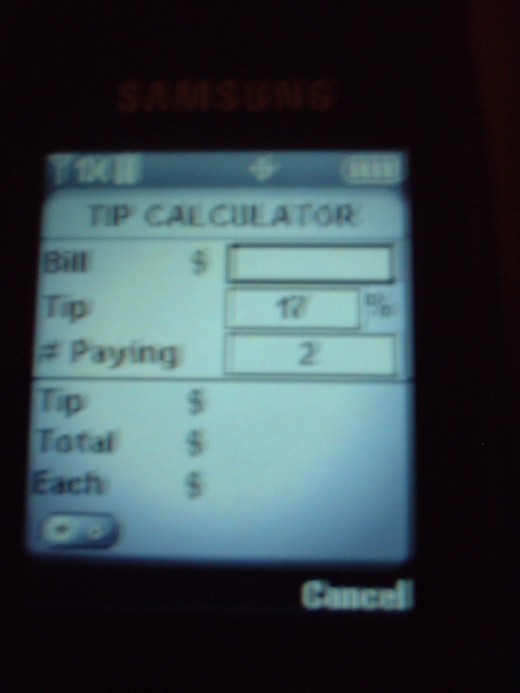
Cell Phone Tool – Nice and Unnecessary
My cell phone has a Tool that allows me to calculate tips based on whatever percentage I choose to use. It also divides up the tab (a restaurant tab, I assume) into equal portions for whatever number of payers I designate.
While it is nice that the cell phone makers have included this tool, it seems wholly unnecessary to me. How often do people actually divide up a restaurant tab into equal portions? If a bill is divided up, is it not more likely that each person will pay for their own unequal portion, tip and all? Granted, there may be situations when an equal division is desired, for a party for example, but can we really not do the math without electronics?
Of course, that is actually a side issue from the calculation of tips. Calculating tips for decimal-based monetary systems can be done with head math (calculation in your head, without benefit of pencil and paper), and I think it is a lot of fun to learn and to use.
The First Skill
The first skill that is necessary is the ability to move a decimal point – not extremely difficult – and the understanding of what that move means. Other steps follow, but that is the first one.
For an amount of money containing dollars and cents (or any other decimal number), moving the decimal one position to the right will multiply the number by ten – not what you want; moving the decimal point one position to the left will divide the number by ten, giving a number that is one-tenth the original. So, for example, with a restaurant tab of $58.79, the number $587.90 is ten times the tab and the number $5.88 (rounded up from the exact measurement of $5.879) gives one-tenth of the tab, which is the same as ten percent (10%).
$58.79 x 10 = $587.90
$58.79 x .10 [1/10] = $5.879,
rounded to $5.88
After Finding Ten Percent, What’s Next?
Most tips nowadays range anywhere from 15% to 20%, so how do we calculate those?
For 20%, simply double the figure that you got from the correct move of the decimal; i.e. double the 10% figure. In the example, double $5.88 to get $11.76, a tip of 20%.
10% x 2 = 20%
$5.88 x 2 = $11.76
If you want 15%, you find the number that is midway between 10% and 20%. With some numbers, that amount is extremely simple to discover, but that is not necessarily the case here. To get the exact amount, take half of the 10% figure (result=$2.94) and add it to the 10% (result=$8.82).
10% / 2 = 5%
10% + 5% = 15%
$5.88 / 2 = $2.94
$5.88 + $2.94 = $8.82
About Rounding
So, is that sort of head math really simple? Sometimes yes; sometimes not so much. But I don’t usually tip to the penny. Why bother? Isn’t a tip supposed to be a representation of appreciation for the staff’s service? Is it really that important to distinguish between $8.82 and $8.80? For me, that distinction is not important, and so I do a lot of rounding when I calculate tips in my head. I figure that the amount of time I spend in being precise to the penny (in this situation) is worth more to me than the $.02 difference. I tend to round up, rather than down, unless it’s a matter of just a few pennies.
In this example, the 10% figure is close to $6, so I would count $6 as being 10%. Twenty percent is close to $12 (exactly 20% is $11.76). Halfway between (15%) is $9 (exactly 15% is $8.82). For me, the rounded figure is usually close enough.
Other Percentages – 18%
What about other percentages, other than 15% and 20%? Use the decimal point again. If you want 18%, just notice that that is 2% less than 20%. Do you see that 2% is 10% (1/10 or .10, one decimal place) of 20%? So, take the 20% tip calculation ($11.76 precisely or $12 rounded up); take 10% of that figure ($1.18 or $1.20) and deduct that from the 20% tip. ($11.76 minus $1.18 = $10.58; OR $12 minus $1.20 = $10.80). Again, decide first how precise you want or need to be.
20% / 10 = 2% (a decimal shift)
20% - 2% = 18%
Precise calculation:
$11.76 / 10 = $1.176,
rounded up to $1.18
$11.76 - $1.18 = $10.58
Rounded amounts:
$12 / 10 = $1.20
$12 - $1.20 = $10.80
Other percentages – 16% or 17%
If you want to tip 16%, use 1/10 of the 10% figure and add it on to the 15% figure. Add one-tenth of 10% twice to get 17%. So, 1/10 of $5.88 (10%) is $.59; add it to 15% ($8.82) to get $9.41. That is 16%. Add $.59 again to get 17% ($10.00).
10% / 10 = 1%
15% + 1% = 16%
$5.88 / 10 = $.588,
rounded up to $.59
$8.82 + $.59 = $9.41
15% + 1% + 1% = 17%
$8.82 + $.59 + $.59 = $10.00
Each time you do this, it will become easier and clearer. It’s a great thing to know, for those times you find you have left your cell phone at home or in the car. Or great to know if you, like me, enjoy working your brain as much as you like working your fingers.